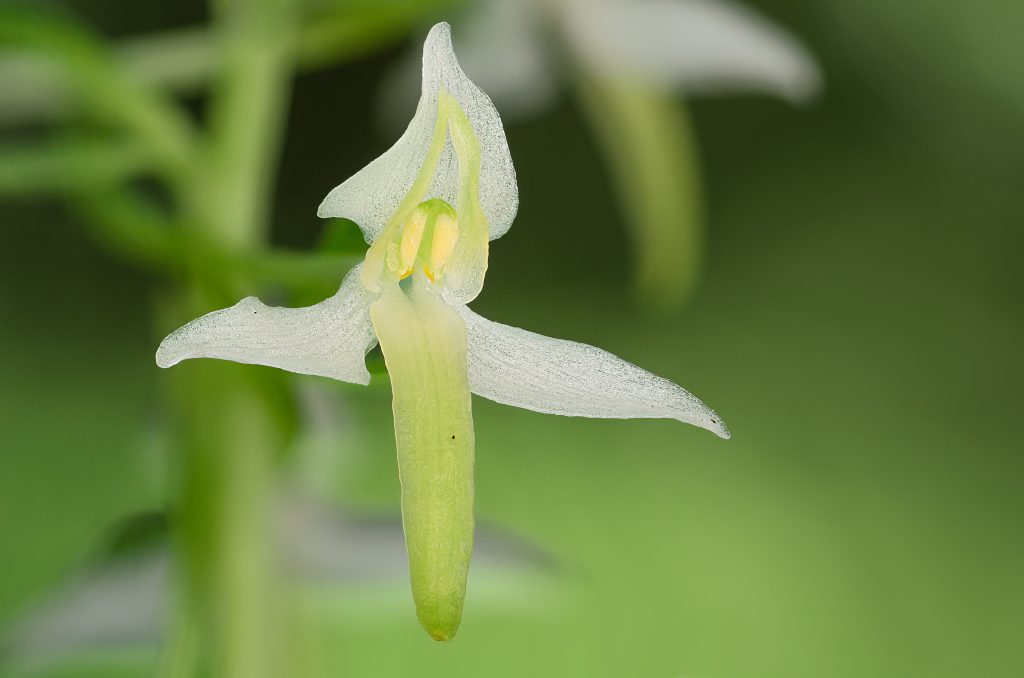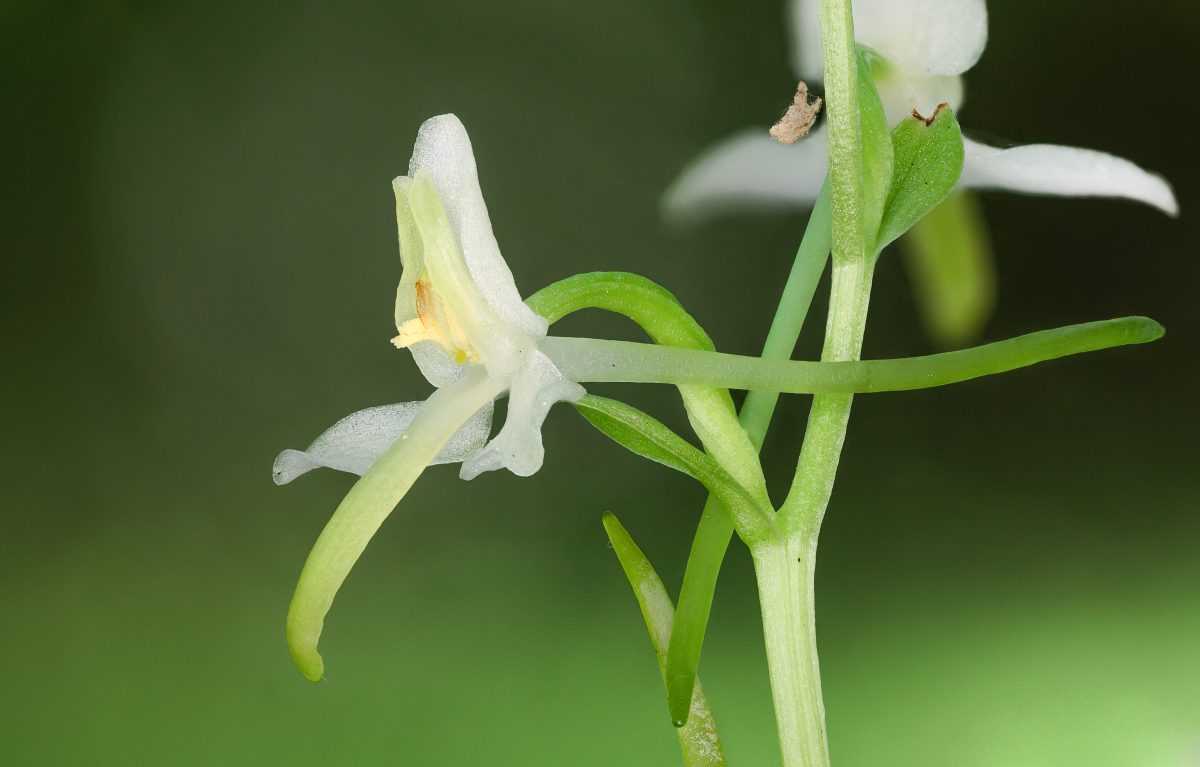
Neither the average Hungarian nor even the average European would imagine just how diverse the Platanthera genus really is. Although, come to think of it, the average Hungarian or European probably doesn’t give Platanthera orchids a second thought in the first place. But if they did, the image that would most likely spring to mind would be an elongated spike adorned with delicate, whitish-greenish flowers, hidden somewhere deep in the forest. This is certainly true of the more “familiar” species, particularly the Lesser Butterfly Orchid (P. bifolia) and the Greater Butterfly Orchid (P. chlorantha). However, as we move away from central Europe towards the Arctic Circle and the Atlantic islands, the orchids begin to look increasingly “peculiar”: their overall stature becomes more Lilliputian, while their flowers grow progressively more reduced and inconspicuous.
But take a giant leap across the Atlantic to North America, and the difference from the Old World becomes so dramatic that the genus is barely recognisable. The American species are positively flamboyant, displaying brilliant colours ranging from purple to orange. Their flower structure is also a world away from that of their European relatives: the perianth elements are broad, the labellum is often divided into three lobes, and these lobes themselves may be deeply dissected and fringed. Hence the American common name: Fringed Orchids. Several hundred species belong to the genus worldwide, although there is no complete agreement on the exact number. Kreutz (2024) mentions approximately 100 species, while other publications put the figure at around 200, the vast majority occurring in North America and Asia.
The number of European species is equally uncertain, as the relentless steamroller of human species-generating enthusiasm seems to have caught up with Platanthera as well. While a more conservative approach recognises eight species on the continent, Kreutz (2024) discusses no fewer than 15. Among these are some rather questionable candidates: for instance, the occasional hybrid between the Lesser Butterfly Orchid (P. bifolia) and the Greater Butterfly Orchid (P. chlorantha) is treated as a species in its own right, which does raise a few questions…
In any case, Platanthera orchids occur throughout Europe, from one end of the continent to the other. They have even made it to North Africa (P. kuenkelei and P. algeriensis), while the Azores, stretching far out into the Atlantic Ocean, can boast three endemic species of their own (P. micrantha, P. azores and P. pollostantha). Until recently, only two species were recognised in Hungary, but this picture now seems to be changing. The taxon previously treated uniformly as P. bifolia has been split into the “true” P. bifolia and P. fornicata, and it appears that both occur in Hungary as well (the presence of P. fornicata is certain).
Their flowers produce nectar in their usually long spurs, an adaptation to nocturnal hawk moths and owlet moths with long proboscises. While these unsuspecting visitors are busy tapping into the sweet bounty, they conveniently carry out the pollination work as well. One particularly characteristic feature of this reproductive strategy is that the flowers release their fragrance at night, filling the air with an intense, honey-sweet scent.