
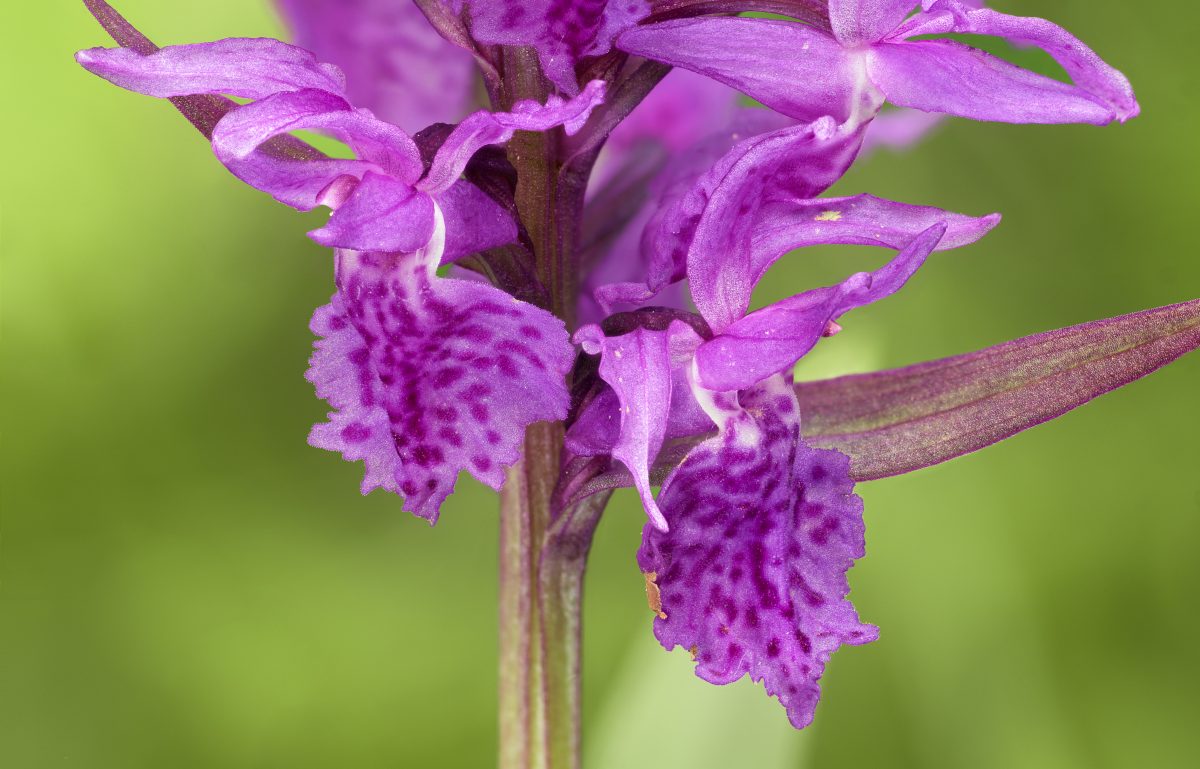
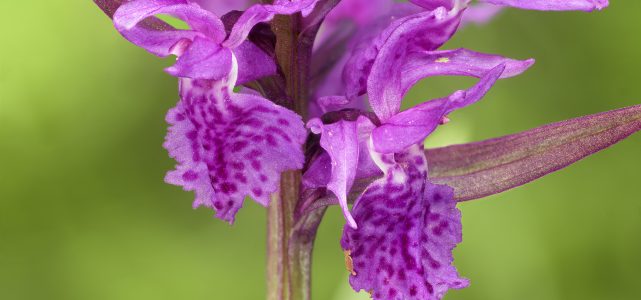
I dare say that the most beautiful “Dacty” is D. euxina. Of course, there are plenty of contenders for the title, including several species I have yet to see in the wild, so perhaps it’s a little premature to crown a winner. Among the runners-up that immediately come to mind are Madeira’s Dactylorhiza foliosa, the unmistakable eastern Dactylorhiza iberica with its loose inflorescence and unique appearance within the genus, the British Dactylorhiza purpurella, whose dark purple flower spike reminds me of a fat pipe, and Dactylorhiza maculata, with its elaborate, almost Rococo-like lip patterns.
Dactylorhiza euxina, however, overwhelms my sense of beauty with the followings: not only are the lips of the individual flowers densely ornamented with large, deep purplish-maroon blotches (and even the tepals are spotted!), but the broad, spreading lip is edged with delicate to rather coarse serrations. As a result, the pointed central lobe often becomes surprisingly difficult to distinguish.
It is therefore no surprise that before our May 2026 trip to Turkey I was eagerly hoping to find this species. Normally it is an early summer orchid, with its peak flowering season falling in June across most of its range (and at elevations above 2,000 metres it may still be in bloom in July). In the lower parts of the Pontic Mountains, however, the earliest plants can begin flowering by mid-May, so our chances did not seem unrealistic. Naturally, it required some research, planning, and a bit of tactical thinking.
We picked a mountain stream in Rize Province and searched several sections along its lower course. Eventually, on a wet meadow right beside the stream, we came across a large population with countless leaf rosettes, among which only two plants were in flower. One displayed the classic features of D. euxina: besides the richly decorated flowers and its rather short stature, it had elongated, heavily spotted leaves reaching up to the inflorescence, with conspicuously dark-striped undersides. The other plant, however, lacked leaf spots altogether. Even so, I do not consider it to belong to the rare var. markowitschii, because its leaves were neither broad and short nor clustered around the lower part of the stem. Naturally, I photographed both plants thoroughly from every angle, so the gallery below features only these two individuals.
Beyond the Pontic Mountains, the species does not extend any farther west (or south), with Giresun being the westernmost province where it occurs. East of there, however, it is by no means uncommon, and can even be quite frequent in Georgia, Armenia, Azerbaijan, Abkhazia, and southern Russia, where it grows in wet meadows along mountain streams and on seepage slopes. Its name commemorates precisely this eastern region, once known as Euxine: the ancient Greek name of the Black Sea was Euxine Mare.
Back to the genus Dactylorhiza ↶


