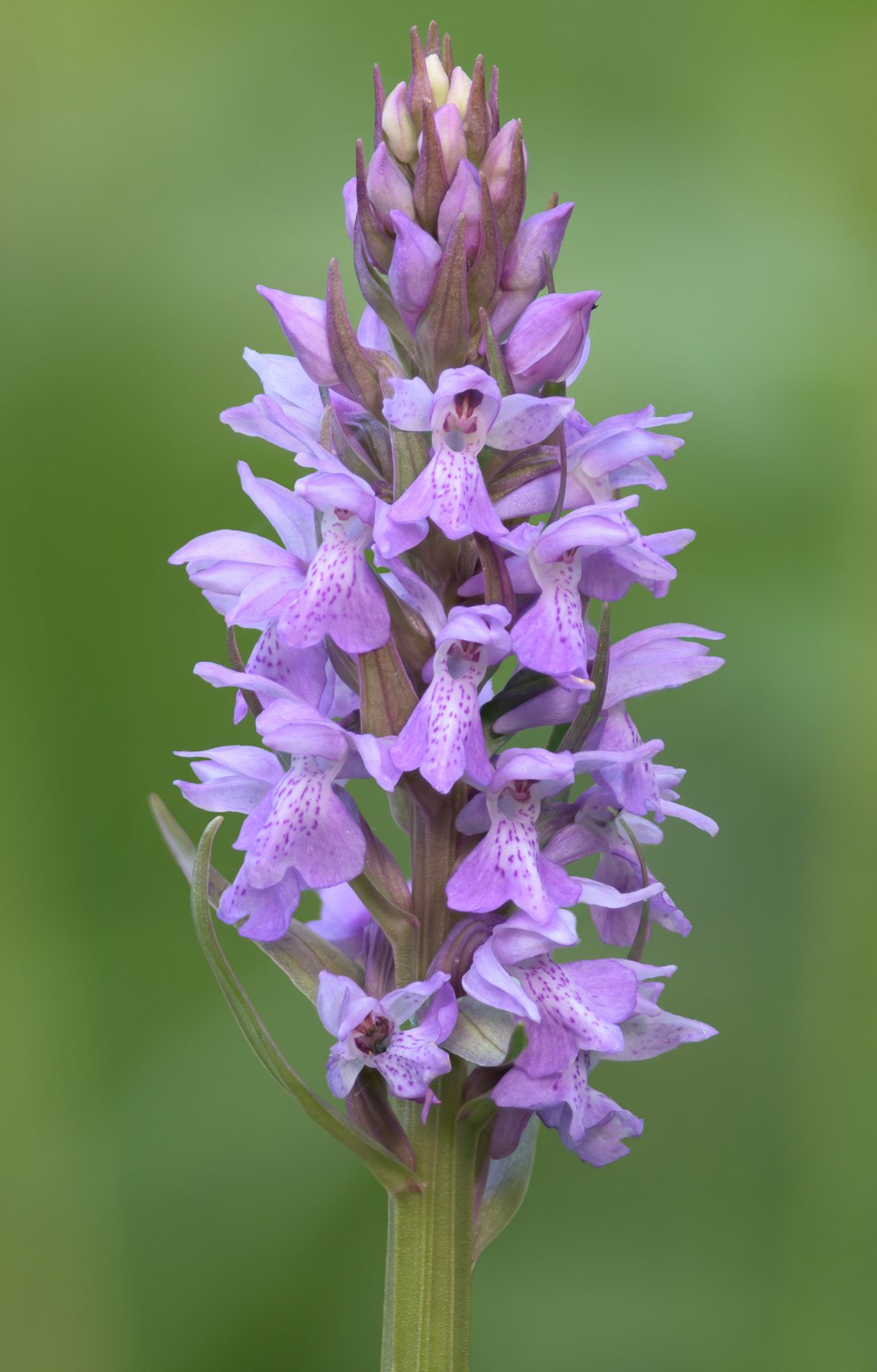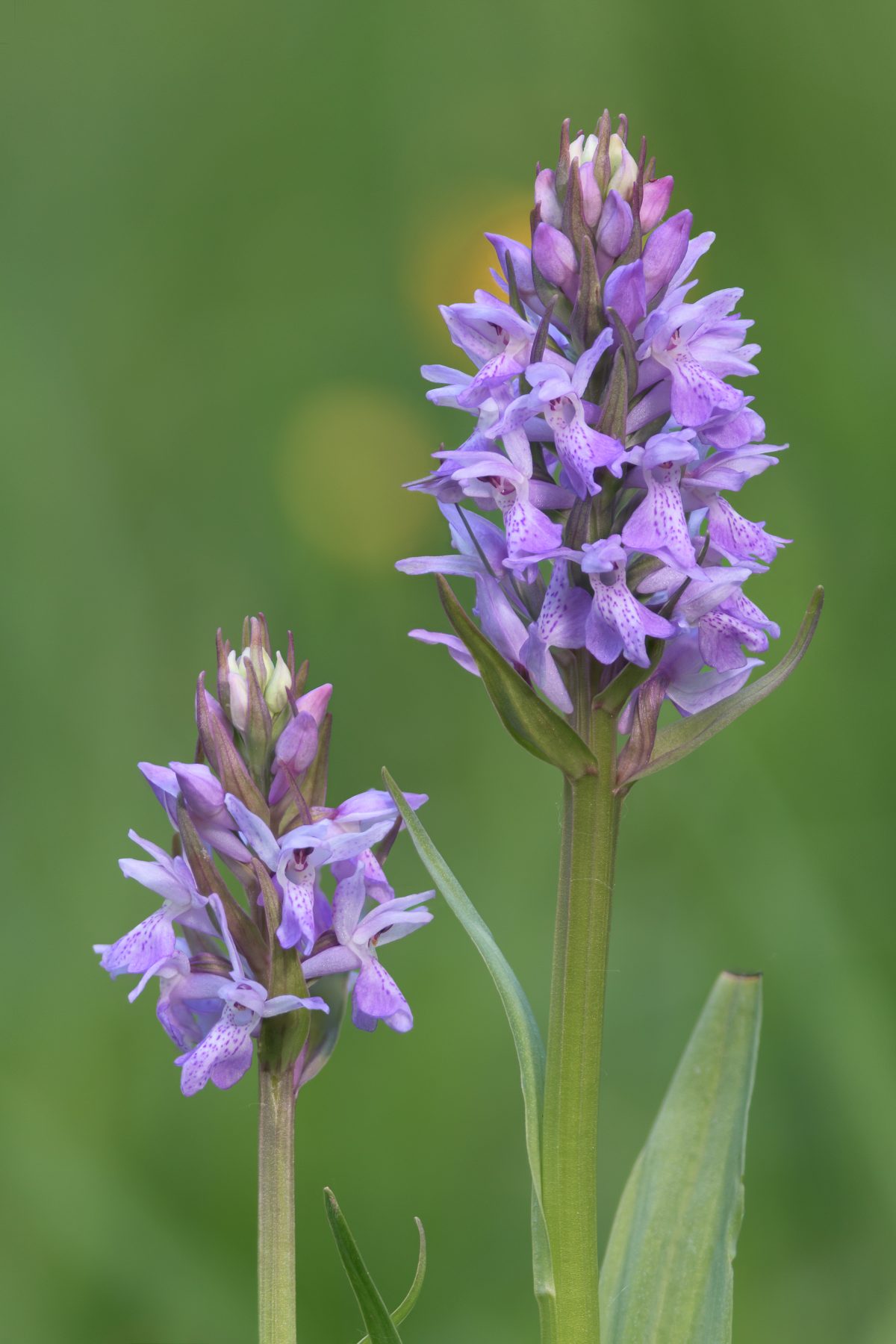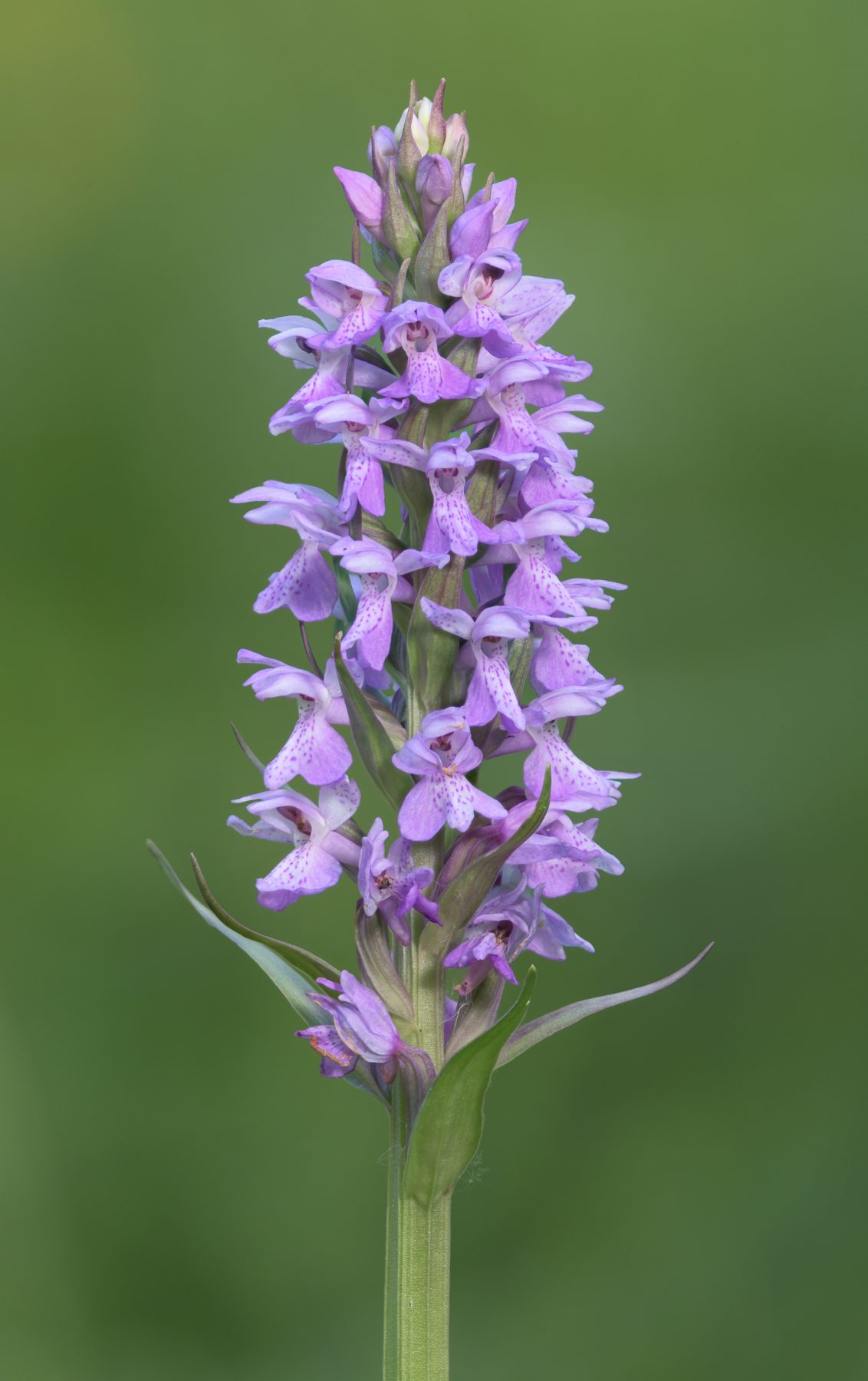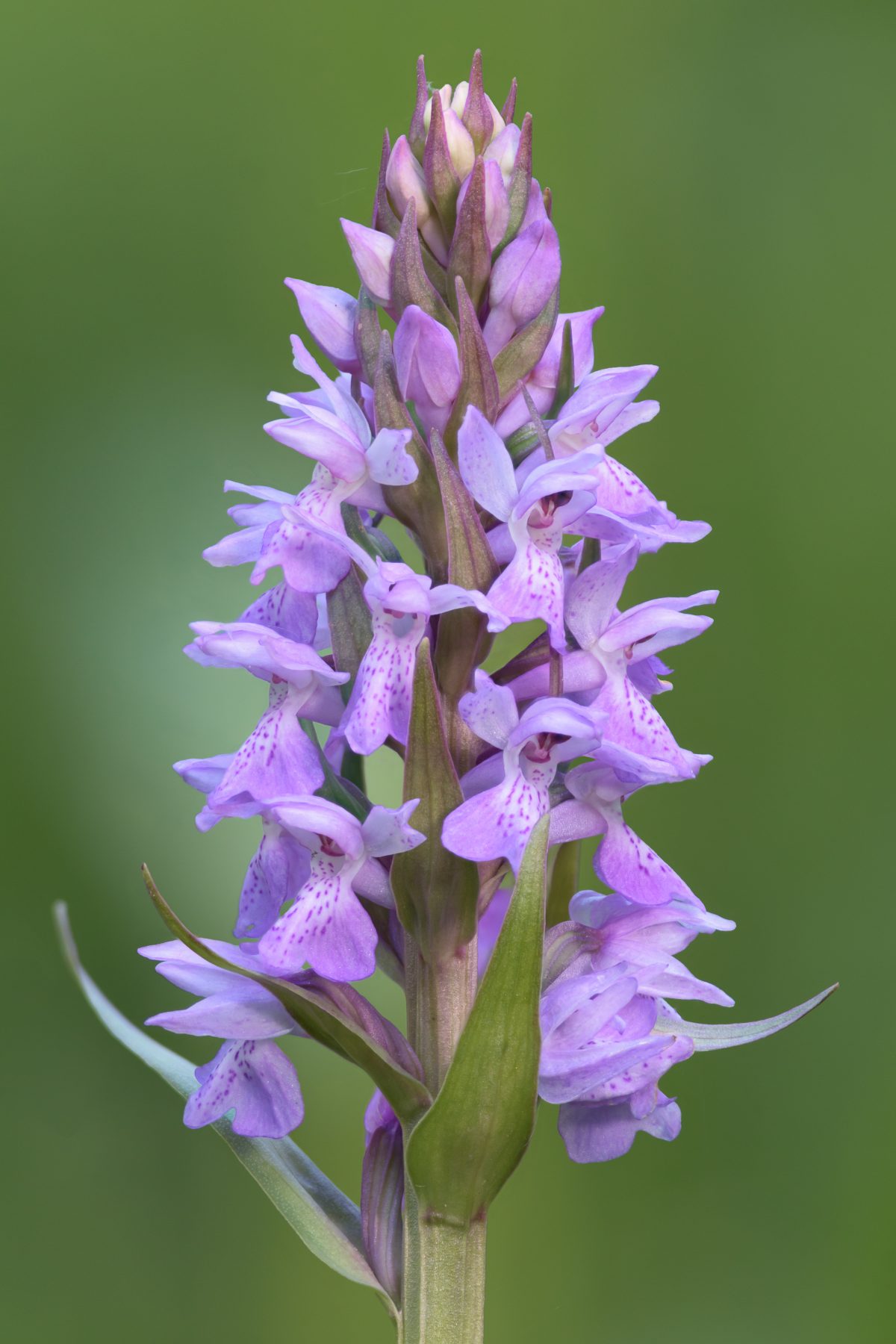
| Etymology: | From the Latin praetermissum, which means overlooked referring to its relatively late description |
| Distribution: | Great Britain (Southern and Middle England, Wales), Northern France, the Benelux countries, Denmark, Norway |
| Flowering time: | late-V. to late-VI. |
| Taxnonomy: | D. praetermissa group |
| Similar species: | D. purpurella, D. kalopissii, D. pindica, D. nieschalkorum, D. pythagorae |
Anyone visiting England in June who has even a passing affinity for orchids would do well to seek out Dactylorhiza praetermissa, as there is a pretty good chance of running into its pale lilac flower spikes in various nature reserves, provided they happen to be sufficiently low-lying, marshy or, better still, somewhere near the coast. These are usually rather “handkerchief-sized” nature reserves in an otherwise thoroughly cultivated English landscape. The species has colonised the southern half of the British Isles with considerable success, while leaving the northern parts to its dark-purple relative, Dactylorhiza purpurella, under the terms of an imaginary territorial partition agreement. The two jurisdictions do, however, overlap in a broad central belt — in Wales and around the latitude of Manchester, for example — where it was essentially a free-for-all: the two sides grabbed whatever territory they could, encroaching on the same marshes and coastal dune slacks. Rather than continuing the hostilities, though, they opted for intermarriage, so anyone wandering into this region can easily find themselves confronted by masses of hybrids.
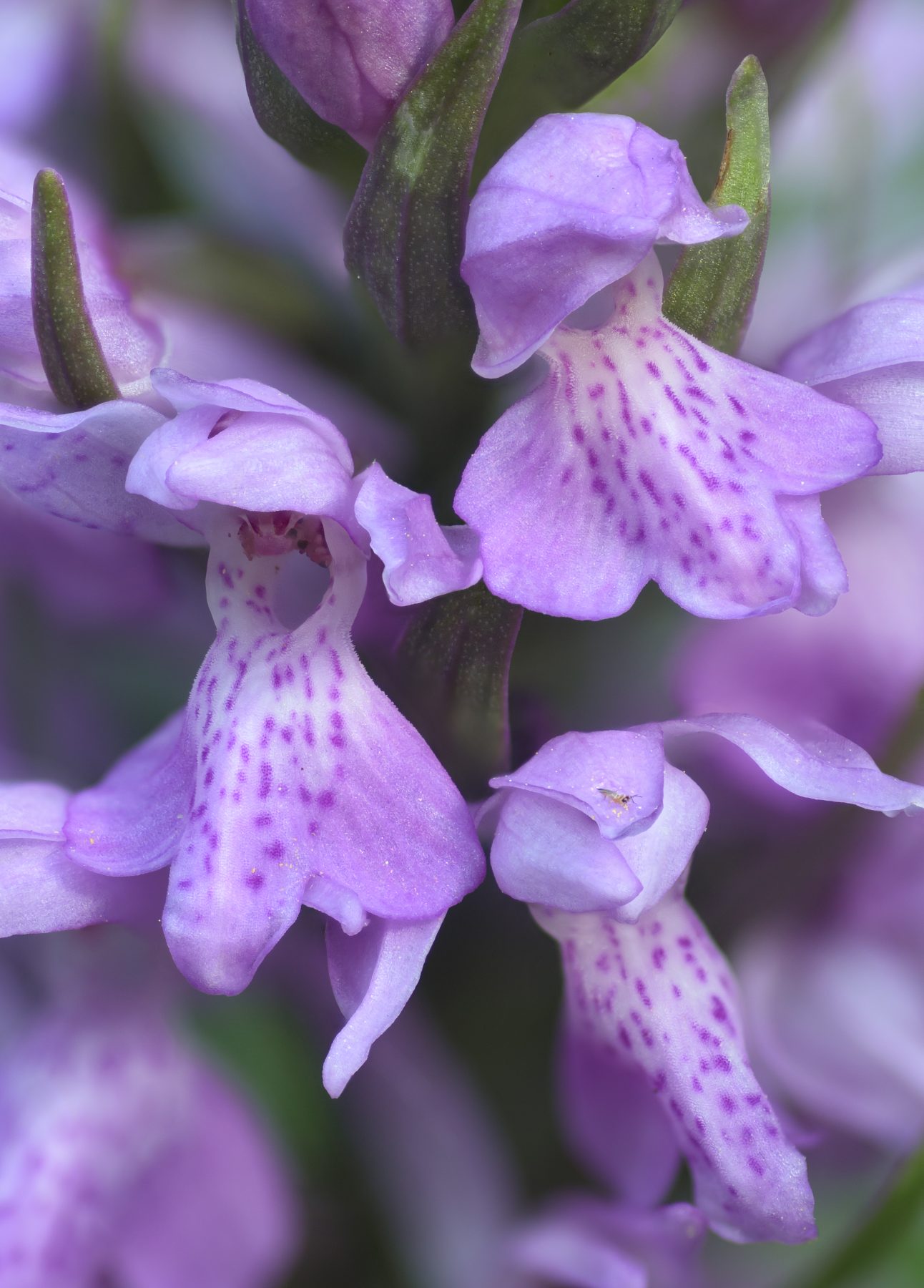
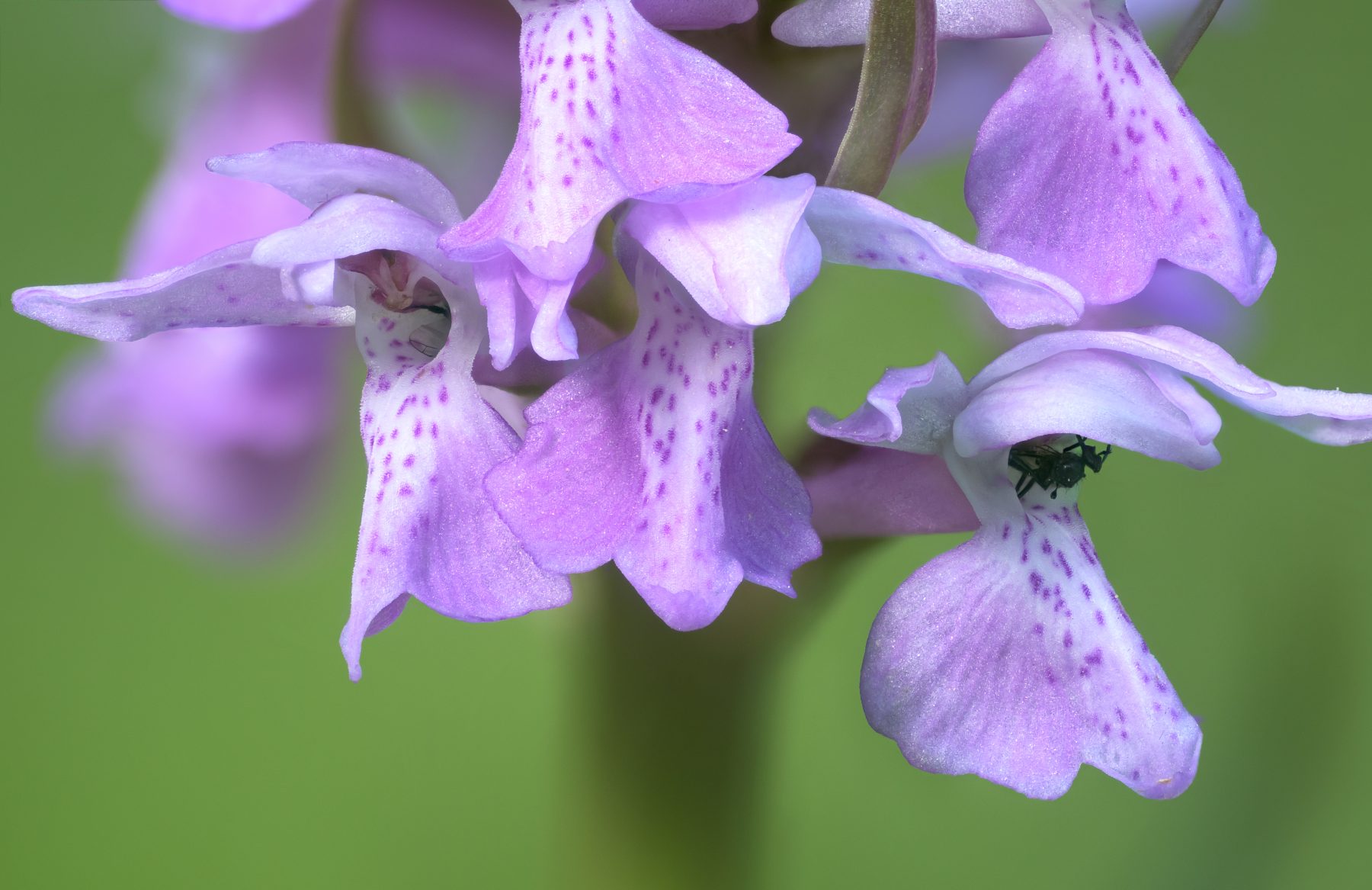
The two species can in fact be confused with one another, although colour usually provides a fairly obvious distinction: purpurella tends to favour a distinctly dark-purple tone, whereas praetermissa is more restrained, sporting paler shades. Of course, both species produce aberrant colour forms (and I am not referring to hybrids here), in which case a few basic morphological characters help expose the impostor. The labellum of praetermissa is more rounded, with a more pronounced central lobe, and its markings consist chiefly of finer, dot-like flourishes. The entrance to the spur is relatively narrow in proportion to the size of the labellum, and the apex of the inflorescence is pointed. In purpurella, by contrast, the labellum is more rhombus-shaped, decorated with thick, dark-crimson continuous lines; the entrance to the spur is relatively broad in proportion to the labellum, and the apex of the inflorescence is more rounded. These characters are all perfectly straightforward to follow — right up until you encounter a hybrid. So anyone who dislikes this sort of challenge would do well to give Wales or Central England a wide berth…!
The species also belongs to the ranks of the spotless-leaved marsh-orchids, although if its vegetative parts do happen to bear spots, it should be referred to as var. junialis. And although I have only been talking about its British conquests, it has made it elsewhere too: across the English Channel and the North Sea, its handsome stems stand their ground as well. Its name (praetermissum — “overlooked” or “neglected”) refers to the fact that it went unnoticed for a long time and remained undescribed, until Druce finally took pity on it in 1914 and christened it Orchis praetermissa. Its definitive Dactylorhiza name, incidentally, was bestowed upon it in 1962 by none other than our Hungarian “pope of orchids”, Rezső Soó.
Back to the genus Dactylorhiza ↶