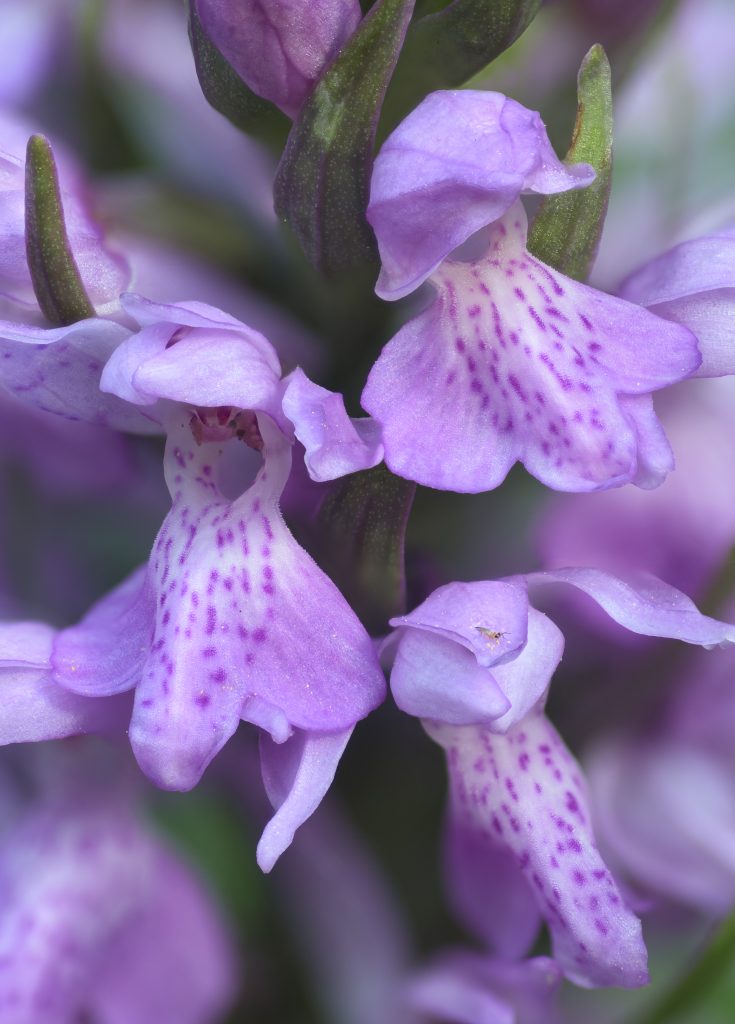
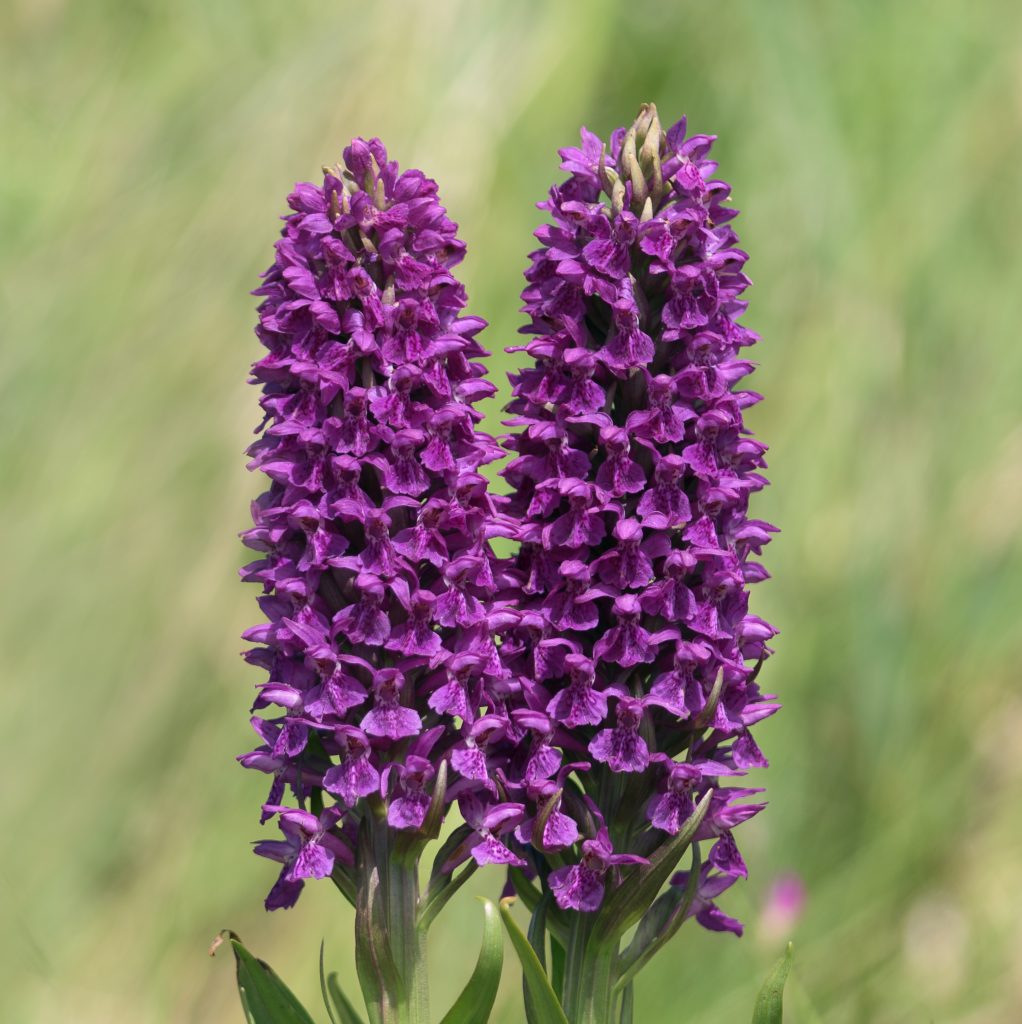
There’s always trouble with marsh orchids. This rather blunt statement mainly comes from our experiences in montane spring fens, where species of Dactylorhiza typically intermingle to such an extent that no one on earth could realistically disentangle the patterns of descent and kinship within such populations. My friend Győző has a fitting expression for this: it’s pure “Dactylorgy.”
All of this is due to the fact that members of the genus hybridize very easily. During hybridization, not only do diploid and sterile offspring arise, but quite often polyploid, fertile descendants are produced, which can then become genetically isolated from their parent species. Because of this effective isolation—reinforced by environmental evolutionary pressures—intense speciation is still ongoing within the genus, resulting in numerous hybrid-origin polyploid species. But this proliferation of species is present not only in nature, but in the scientific literature, too. While Delforge’s major orchid work from 2005 listed around 70 species, Kreutz’s 2024 book already includes about 140 species—meaning the number of taxa has doubled in 20 years. Even marsh orchids aren’t quite that trigger-happy…
The genus is distributed across Eurasia, with a few species occurring in Africa and Iceland, a single species on Madeira (namely Dactylorhoza foliosa), and extending eastward as far as Siberia and the Himalayas. Its members prefer light and moisture, often appearing in fens and marshy habitats. Their roots are characteristically finger-like (resembling the fingers of a hand), which is reflected in both the Hungarian and Latin names: dactylos meaning “finger” and rhiza meaning “root.” Their stems may be slender and solid, as in the D. maculata group, or thick but hollow, which is typical of the D. incarnata group. From an evolutionary perspective, these are the two central lineages whose members, by hybridizing with one another, have driven the previously mentioned proliferation of polyploid species.
Occasionally, they also hybridize with members of other genera. Intergeneric hybrids have been observed with Gymnadenia and Nigritella (the latter being truly astonishing in appearance). In fact, I myself have encountered the “love child” of the fragrant orchid (Gymnadenia conopsea and G. odoratissima) and the common spotted orchid (Dactylorhiza fuchsii).
In Hungary, there are a total of seven species, none of which can be considered abundant. Perhaps the early marsh orchid (Dactylorhiza incarnata) has the largest populations, while the broad-leaved marsh orchid (Dactylorhiza majalis) still has more significant stands in the Őrség/Vendvidék region.