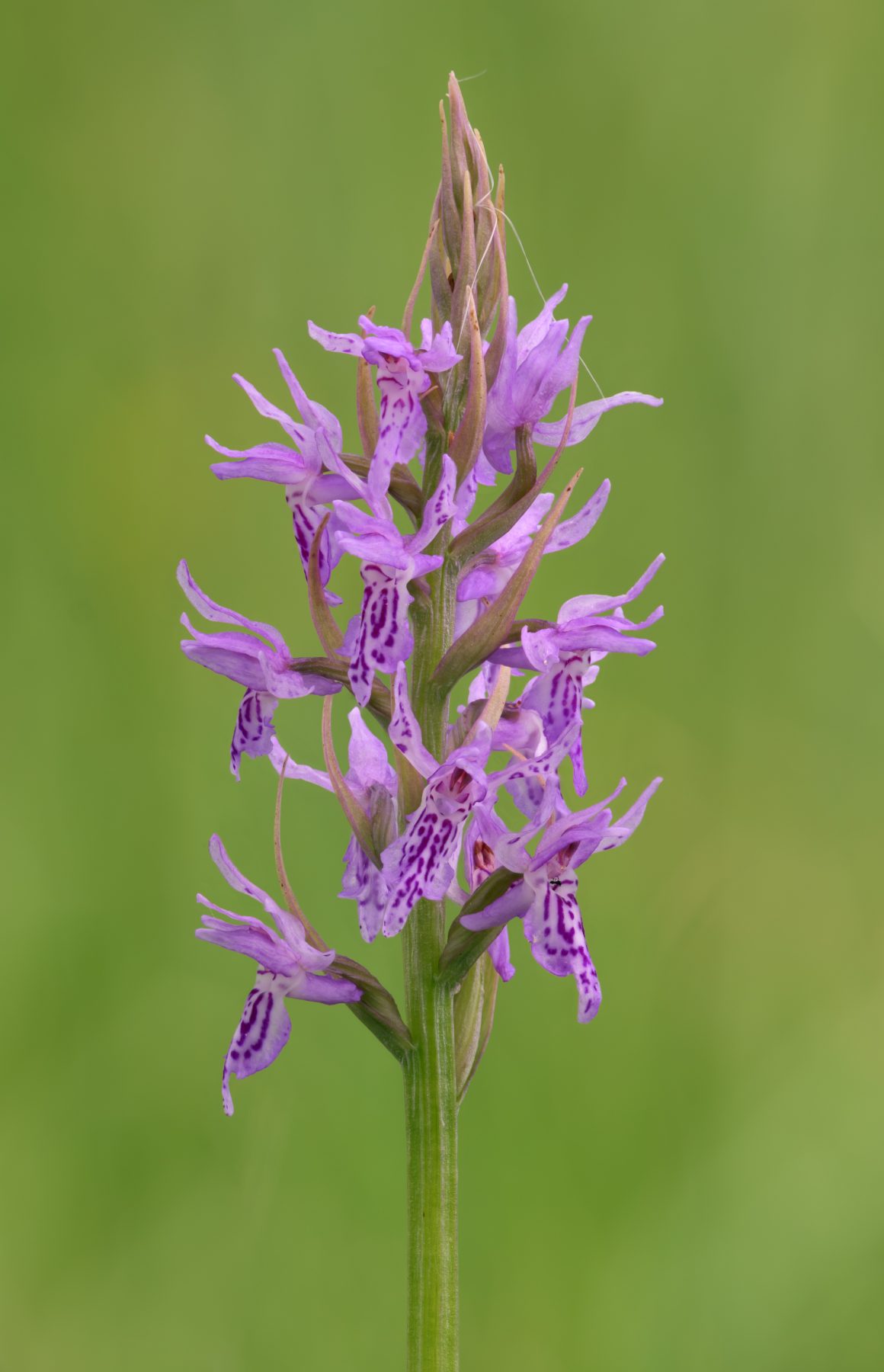
The common spotted orchid (Dactylorhiza fuchsii) in Hungary is indeed more closely associated with forests—although even here it most often appears in meadow patches at forest edges, fen meadows, roadside cuttings, or on former slurry deposits. Elsewhere, however, it is primarily an orchid of sunny mountain meadows and more open woodlands. In Hungary it is quite rare, whereas across Europe, especially in mountainous regions, it is encountered frequently—you can often spot it simply by scanning the green roadside verge from a car.
There is no full consensus regarding its taxonomic rank. “Splitter” botanists treat it as a distinct species, while others, such as Taraška et al. (2023), based on cytological and morphological analyses, consider it part of the heath spotted orchid species complex (Dactylorhiza maculata agg.), and accordingly propose the name D. maculata subsp. fuchsii. They also point out that the common spotted orchid, which is generally diploid, likely diverged from the tetraploid ancestral D. maculata, and even today it is not sufficiently distinct to be unequivocally separated on morphological grounds alone.
Thus, it can be said that the main differences between these otherwise very similar taxa are that in D. fuchsii the middle lobe of the labellum is larger and extends beyond the lateral lobes (in D. maculata this beak-like lobe is much shorter); its basal leaves tend to be more ovate-elongate (those of D. maculata are more elongated-lanceolate); and it is often noted that one prefers acidic soils while the other is more typical of basic substrates. However, these distinctions are often blurred, and in some individuals they are not clearly discernible. Even in the gallery below there are examples of such uncertainty—particularly in the Dolomite specimens, where I am not entirely convinced of the correctness of my identification. Where other Dactylorhiza species also occur, the situation becomes even more tangled.
In Hungary, most populations can be found in the Mátra and the Zemplén Mountains. These plants typically have snow-white flowers with lilac markings—a geographically isolated and widespread trait that has even been described as a separate taxon. Here too, there is disagreement over rank: some authors, such as Molnár & Csábi (2021), treat it as a variety of D. fuchsii (var. sooana), while Taraška et al. (2023) classify it as a subspecies of D. maculata (D. maculata subsp. sooana). This form, named after the renowned orchidologist Rezső Soó, also occurs in western parts of the Carpathians (Slovakia). The lilac-based “typical” form of D. fuchsii in Hungary is found only in the southwest—in Zala, the Őrség, and the Bakony—and has also recently been discovered on the northwestern edge of the Central Mezőföld, at an unusually low elevation. Apart from the Mátra, it is nowhere abundant, usually appearing in small groups or as scattered individuals.
It readily hybridizes with other marsh orchids. Due to its rarity in Hungary, hybrids have so far only been recorded with the early marsh orchid (Dactylorhiza incarnata) and the broad-leaved marsh orchid (Dactylorhiza majalis). In Europe, however—especially in montane spring fens where other Dactylorhiza species thrive—hybridization is very common, sometimes to such an extent that identifying individuals based solely on morphology becomes impossible. The gallery below also contains many specimens that I could only identify approximately after much deliberation. It can also hybridize with other genera, producing striking and unusual hybrids. Crosses with fragrant orchids (Gymnadenia) are rare but documented—below in the gallery, as well (e.g. D. fuchsii × G. conopsea and D. fuchsii × G. odoratissima), and it can even hybridize with the sole species of Pseudorchis (P. albida) and with Nigritella species—the latter often resulting in particularly crazy-looking plants.
In Hungary, its small populations are vulnerable. The species is highly exposed to the impacts of forest management, and overabundant game populations can also reduce its numbers. Despite this, its official conservation value is rather symbolic, amounting to only 10,000 HUF.
Back to the genus Dactylorhiza ↶