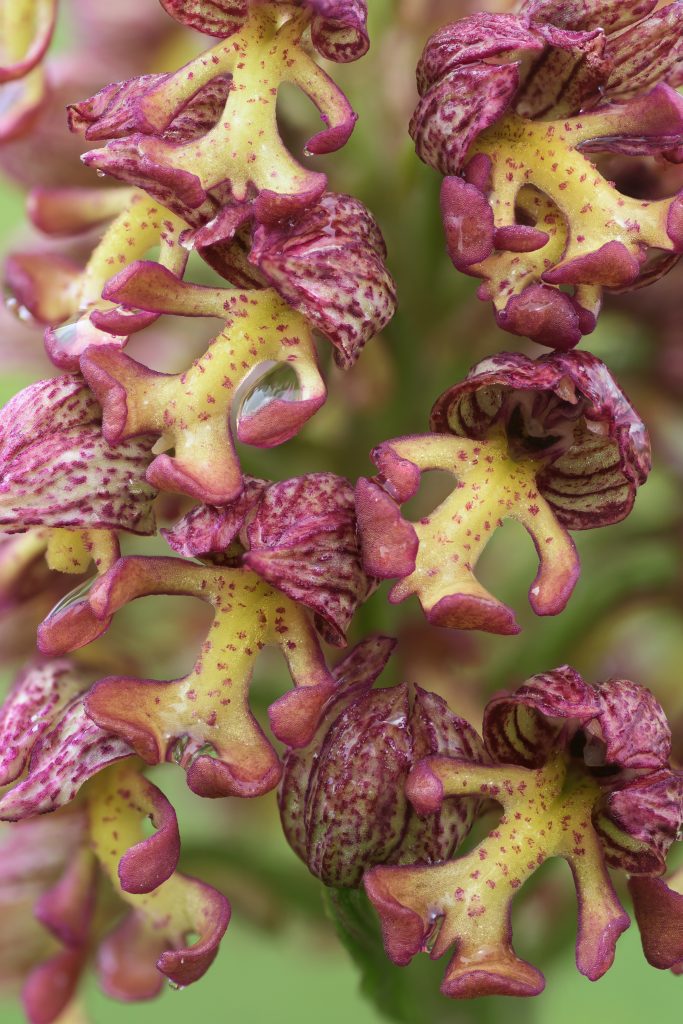
The genus Orchis in the strict sense has become rather depopulated over the past few decades. Phylogenetic research has revealed new relationships within the group, effectively blowing apart what was once considered a diverse but unified assemblage (and in truth the process began much earlier—after all, in the time of Carl Linnaeus nearly everything was placed in Orchis). As a result, a number of well-known and familiar “orchids” have had to leave this once-comfortable taxonomic umbrella and find their place in other genera.
Among those reassigned are the green-winged orchid (Anacamptis morio), Anacamptis palustris, the toothed orchid (Neotinea tridentata), and the burnt orchid (Neotinea ustulata), as well as the Mediterranean butterfly orchids (Anacamptis papilionacea) and Anacamptis sancta. As a kind of consolation prize, however, one species moved in the opposite direction: the plant long known as Aceras anthropophora is now generally included within Orchis. Not everyone agrees with this change, however—for instance, C. A. J. Kreutz declined to accept it in his 2024 monograph.
The species that remain within Orchis share several characteristic features: a relatively robust habit, dense spikes bearing numerous flowers, and blossoms whose sepals form a helmet-like hood. The labellum is typically spotted. These orchids produce no nectar; instead, they rely on deception, attracting pollinators through visual signals and scent. The genus is widespread across Europe and also occurs in Asia Minor, the Caucasus, North Africa, and the Middle East. Five species are found in Hungary.
Kreutz also argues inhis monograph, that the already much-reduced genus should be split even further. His proposal is based primarily on morphological characters, but he also highlights an important observation: two clearly defined groups can be recognized within the genus whose members do not hybridize with those of the other group (although hybridization does occur within each group). One group includes the pale orchid (Orchis pallens), the early-purple orchid (Orchis mascula) and its close relatives, as well as Orchis spitzelii. The other contains species such as the lady orchid (Orchis purpurea), the military orchid (Orchis militaris), the monkey orchid (Orchis simia), and the eastern Mediterranean Orchis punctulata. The former group has even been given a new generic name, Androrchis.
Nevertheless, on my website I continue to follow the nomenclature adopted in the Atlas of the Orchids of Hungary.