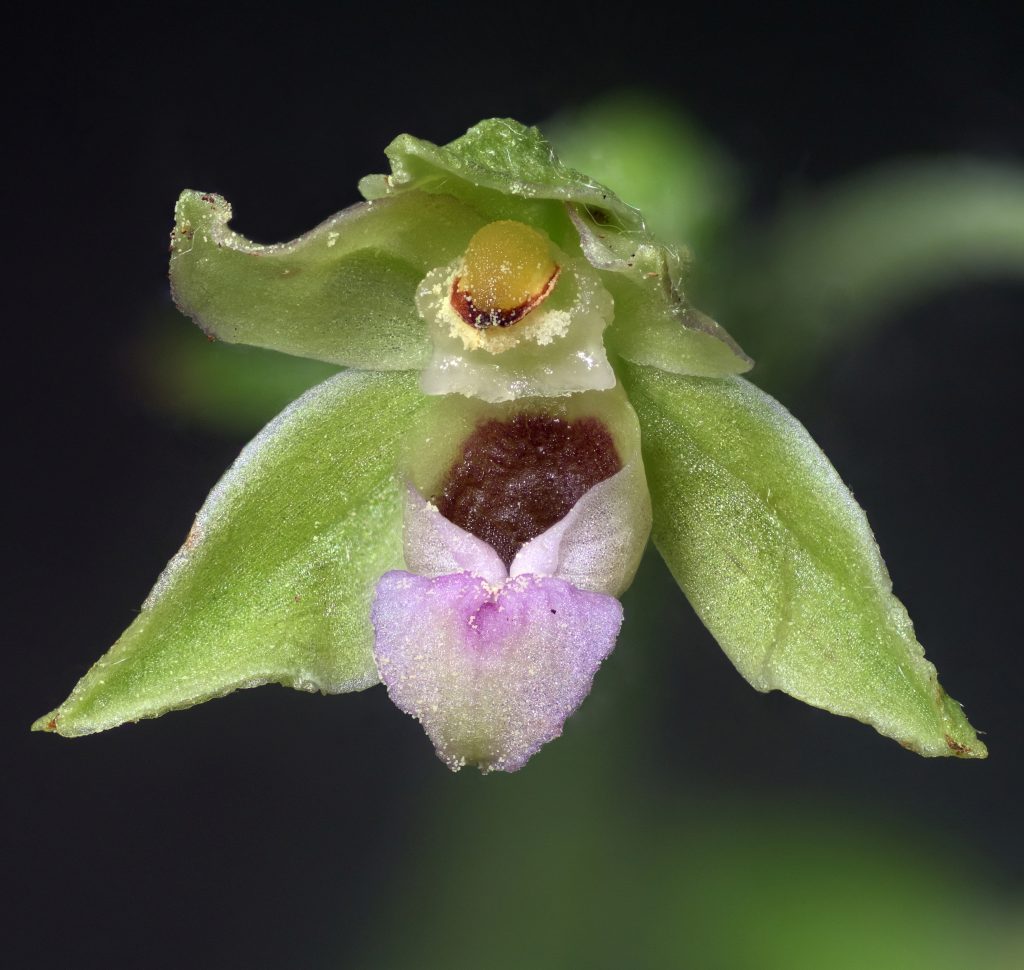
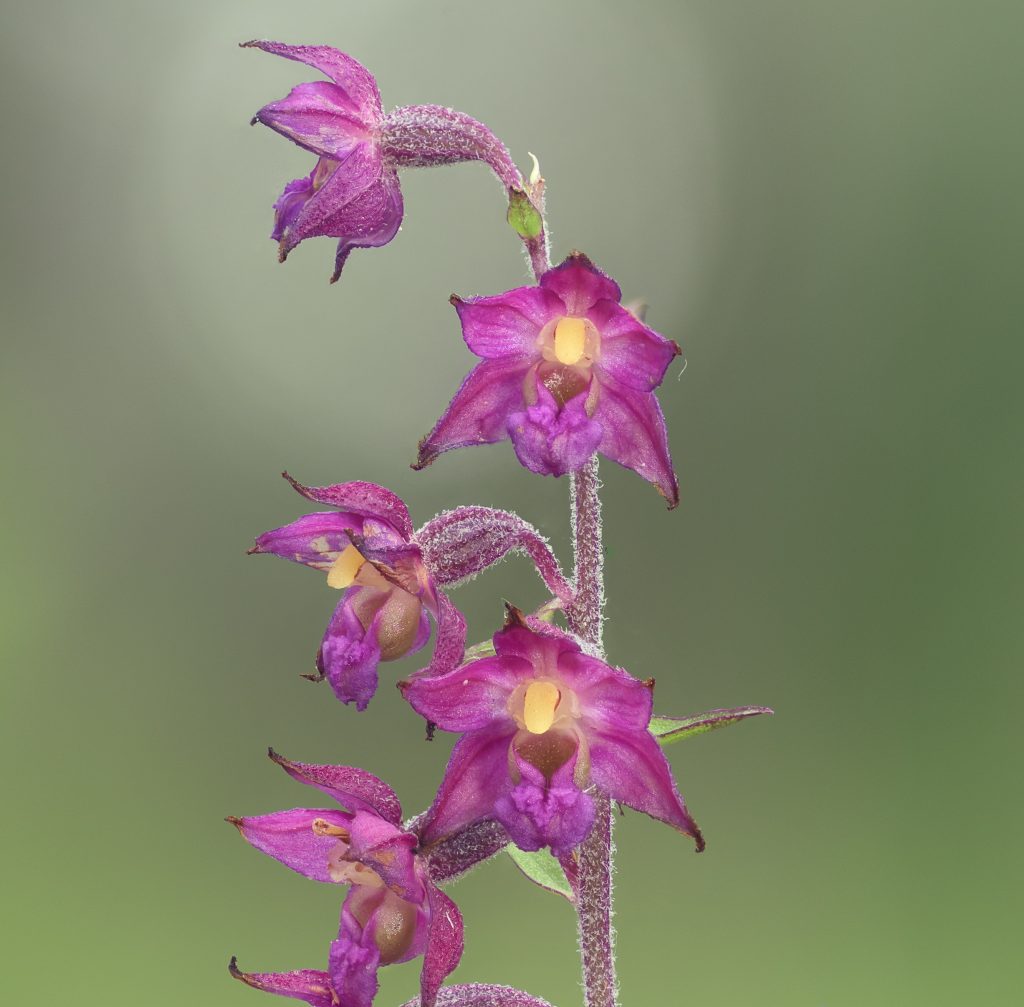
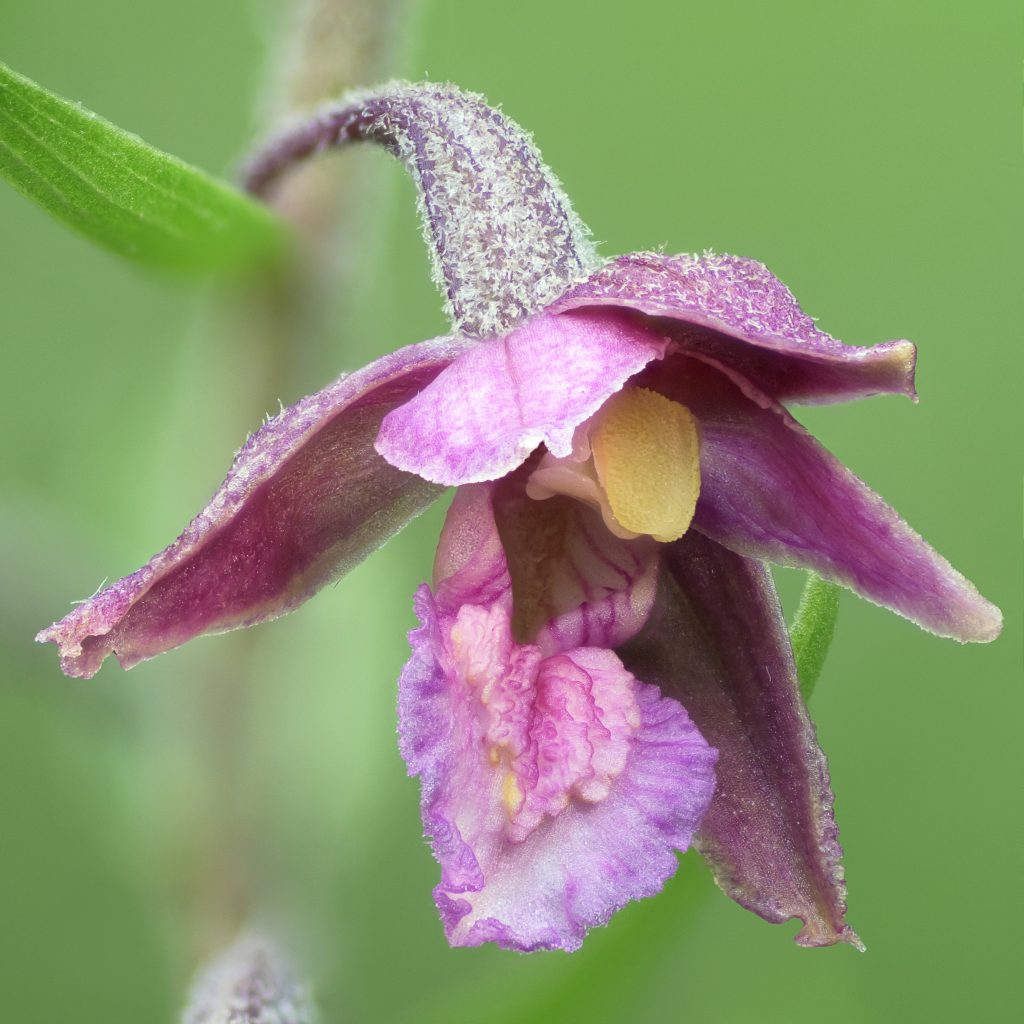
Identifying species of Epipactis requires meticulous, nitpicky work, but that’s exactly why I find this genus so fascinating. You have to pay attention to every detail: thoroughly examine the plant, the color of the stem base, the shape and size of the leaves, the internodes, the length and orientation of the inflorescences—but what demands the most detailed attention (and where a magnifying glass can be very useful) is the flower itself and its associated structures: the perianth, the labellum, and the column.
At first, it may not seem obvious, but studying the column immediately helps determine whether the plant is insect-pollinated (allogamous) or primarily self-pollinating (autogamous), which already narrows down the possible species. So it’s worth starting with this step. For further refinement or final identification, one can examine the labellum, leaves, stem, inflorescence, and even flowering period in sequence.
But what exactly should one pay attention to in the flower? Which are the key “components” that aid identification? The main elements are shown in the diagram below. Like most orchids, the perianth is in two whorls: two sepals are lateral, and the third bends over the labellum from above (dorsal sepal). The inner whorl has two petals, while the third petal is modified into the labellum. The labellum itself is bipartite: an inner, elongated hypochil resembling a cup or tub, shiny with nectar at the bottom, and an outer, usually heart-shaped, rounded epichil. In most Epipactis species, the epichil transitions continuously into the hypochil via a constriction called the mesochil. Some Epipactis—forming the so-called Arthrocilium or palustris group—lack this mesochil, so there is a noticeable gap between epichil and hypochil. This gap plays a crucial role in pollination: insects landing on the labellum can easily push the epichil down with their weight, which, as they move further into the flower, presses their head against the column, ensuring pollination. These Epipactis with such labellum morphology are strikingly showy, as seen in the marsh helleborine (Epipactis palustris), Epipactis veratrifolia, or Epipactis gigantea.
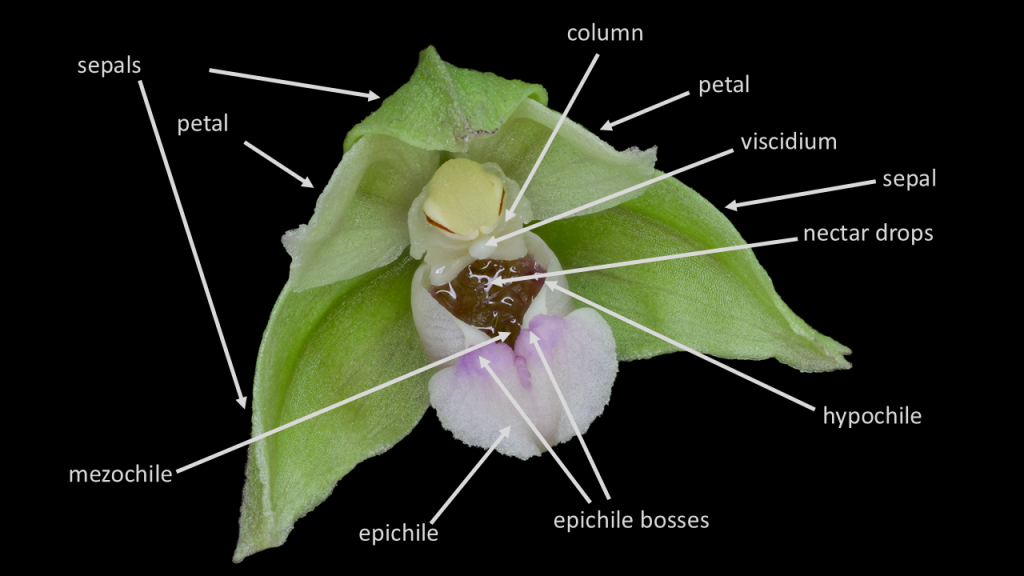
The most challenging structure to study is the column itself. It is small and often hard to access to clearly observe all the essential parts. The constant element is the double anther at the top, containing the pollen masses (pollinia or pollinarium). Directly beneath it, there is often a small, spherical protuberance—the viscidium—which functions to attach the pollinia to the head of visiting insects. In autogamous species, the viscidium is either nonfunctional (does not stick) and dries out during flowering or is entirely absent. The lower part of the column bears the sticky stigma, a relatively constant structure in both position and form.
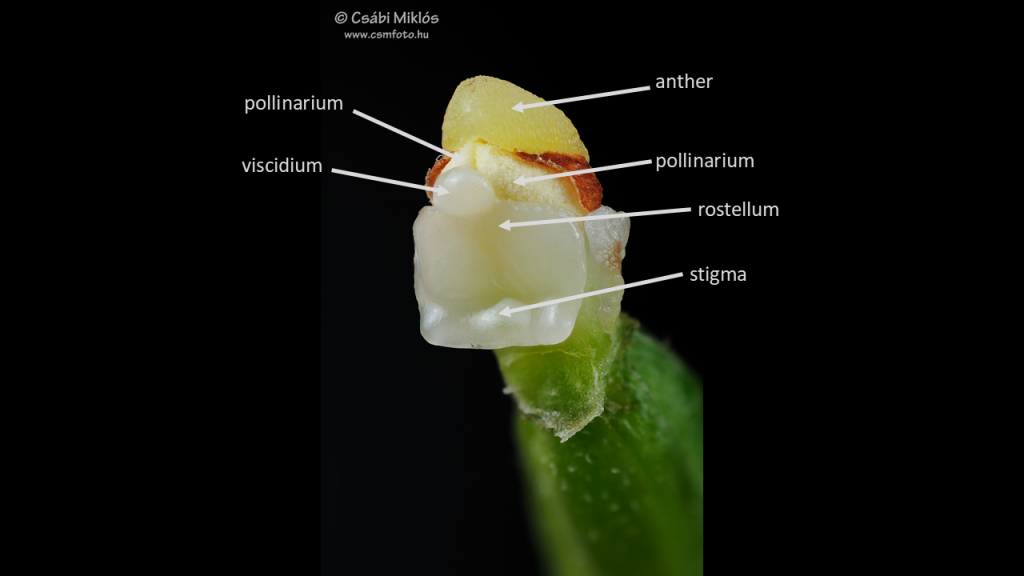
This brings us to the most critical components: the rostellum and the clinandrium. The rostellum is a vertical, often slightly overhanging wall that, in insect-pollinated species, prevents the cohesive pollinia from accidentally contacting the stigma beneath. The clinandrium is the depression in the column’s surface into which the pollinia fit. In allogamous Epipactis, the rostellum is well-developed with a wide rim, and the clinandrium is deep, holding the pollinia securely and preventing self-pollination (see the image of broad-leaved helleborine above).
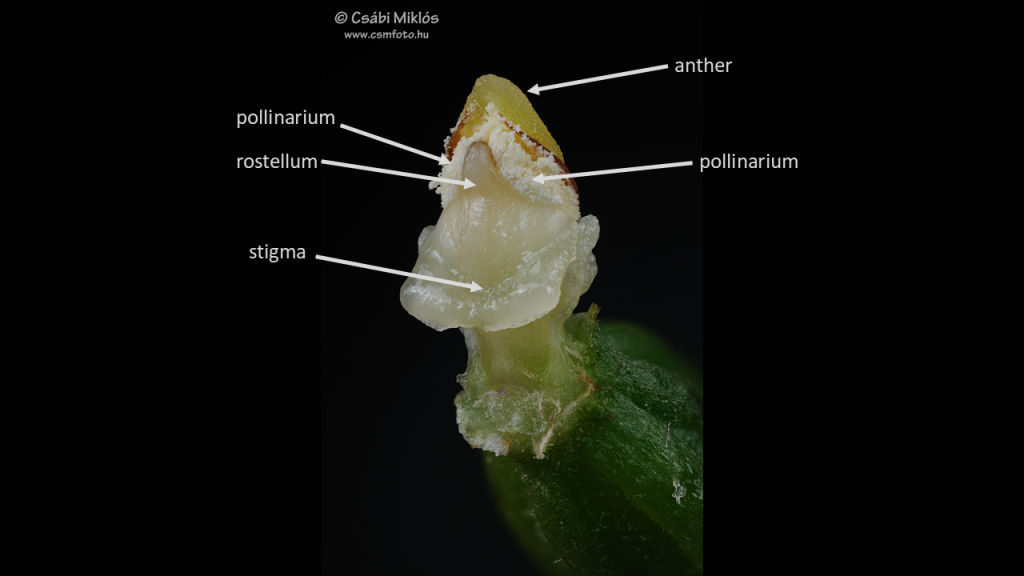
In contrast, in many autogamous Epipactis, the rostellum is reduced, tapering upward, lacking a distinct overhanging rim, and the clinandrium is shallow. The photo above shows an example from a narrow-lipped helleborine (Epipactis leptochila), where the pollinia, being less sticky in autogamous species, break into small grains that easily fall onto the stigma.
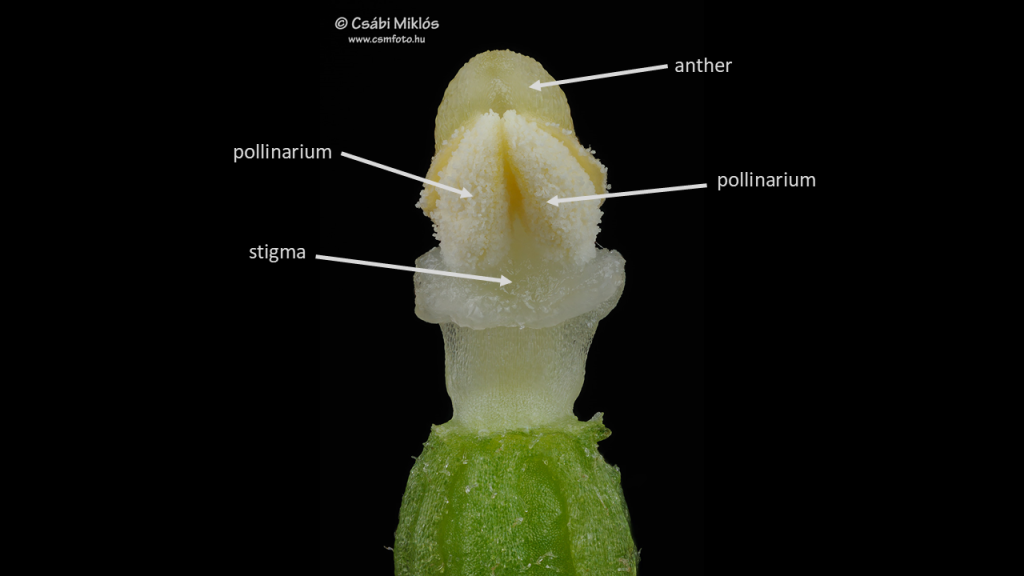
In extreme cases, the rostellum may be entirely absent (no viscidium), the clinandrium becomes a flat platform, and the pollinia rest directly above the stigma, facilitating automatic self-pollination. In the case of such a column structure pictured in the above photo belonging to Epipactis placentina, pollen can immediately fall onto the stigma due to the lack of any physical barriers. This column type is often referred to as muelleri-type, named after the type species, Epipactis muelleri.
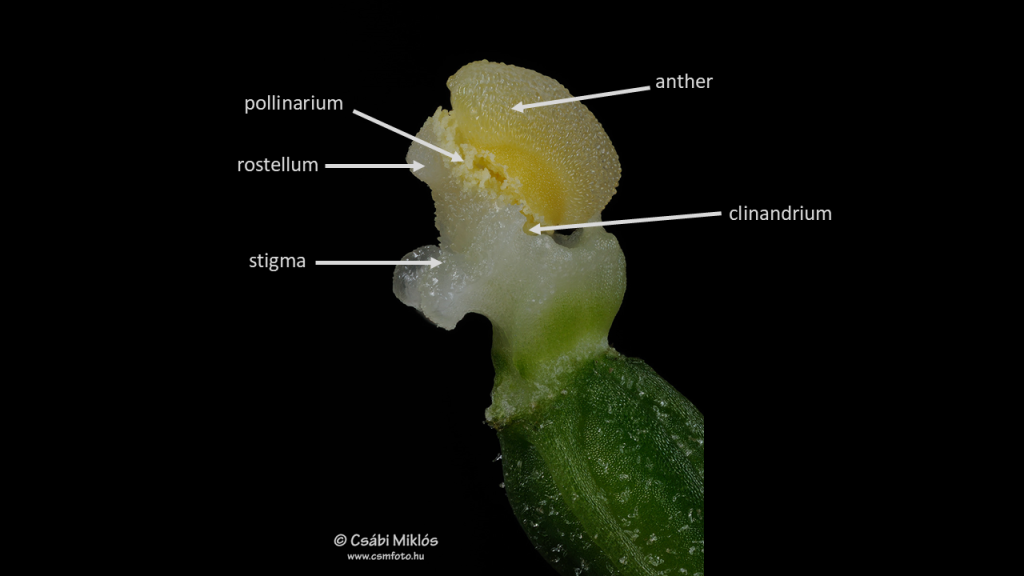
The clinandrium is difficult to observe directly, as the pollinia and anther can obscure it, and thorough examination would require their removal, which is not recommended as it could disrupt pollination. The lateral view above indicates its location. Studying the rostellum alone is usually sufficient to determine the pollination strategy.
Most Epipactis taxa in Hungary are autogamous, with only a few insect-pollinated species. Examples of allogamous species include members of the Arthrocilium group, marsh helleborine (E. palustris), Epipactis veratrifolia, Epipactis gigantea, broad-leaved helleborine (Epipactis helleborine), violet helleborine (Epipactis purpurata), and red-brown helleborine (Epipactis atrorubens). Beyond these, all other Epipactis in Hungary reproduce via self-pollination. Some are so confident in their autogamy that they never even open their flowers; for example, Futák’s helleborine (E. futakii) remains closed, flowering naturally only up to the bud stage—a phenomenon called cleistogamy.
Autogamy has allowed Epipactis to spread widely across temperate and Mediterranean-subtropical Europe and into Africa (Epipactis veratrifolia reaches Somalia), eastward to China, the Himalayas, Thailand, Siberia, and Japan. Epipactis gigantea has colonized the USA, and Epipactis helleborine has become an adventive species there. As for habitats, most prefer shade, typically in closed, near-natural or planted forests, especially with sparse understory, though some thrive in open wetlands (Epipactis palustris), light forests (Epipactis muelleri), or warm, xerothermic oak forests (Epipactis latina). Others tolerate sunny dunes, clearings, or seepage areas.
In allogamous species, pollination is mainly carried out by wasps or flies, with nectar offered as a reward, typically at the base of the hypochil, except in Arthrocilium, where it is stored at the rear of the epichil. Autogamous species also produce nectar.
Autogamy has contributed to a surge in described new taxa across Europe in recent years, often based on single populations and geographic isolation. Consequently, modern orchid monographs (e.g., Kreutz’s 2024 major work) present a flood of Epipactis species, which can be overwhelming for those trying to navigate them.
The total number of species in Hungary depends on taxonomic interpretation—whether certain variants are considered separate species or subspecies. Ignoring helleborine variants (moratoria, latina, minor, leutei, distans) and including Epipactis karolyii described by Óvári (2023) in his monograph about the orchids of Zala County in Hungary, there are 21 species in total, making Epipactis the richest orchid genus in Hungary. Most species are rare and occur only at a few locations, with three enjoying strict protection status.